
For me, part of travel is immersing myself in culture. I want to understand the systems, the people, and the food of a specific country and I want to know how they came to be. I love museums and historical spaces because they lend so much context to the place I am visiting.
In Cebu, much of the cultural texture relates to the majority belief in Catholicism. When Magellan landed in Cebu in 1521, he introduced the people to Catholicism and Rajah Humabon embraced it. As a result, Cebu is known as the “cradle of Christianity” in the Philippines.
During the years I lived in California, I visited many Spanish missions. When I was in college, I spent a lot of time with friends at the Catholic Newman Center. Between the two, I know Spanish colonial church architecture fairly well, which meant the cathedral and basilica were not particularly calling to me. I looked for other landmarks instead.
Fort San Pedro
I love forts and old settlements. Walking through them, I find myself thinking about the people who lived and worked there: what their daily routines looked like, what they were afraid of. Fort San Pedro was the first permanent Spanish military defence structure in the Philippines. The original was timber, raised after the arrival of Miguel López de Legazpi in 1565, the first governor of the Captaincy General of the Philippines. The Spanish had chosen Cebu as their foothold in the archipelago partly because Legazpi found a friendly reception after Magellan’s earlier contact, and the fort was built to defend the settlement against Moro raids from the south and the threat of rival European powers moving in on the same trade routes.
The structure was rebuilt in stone sometime in the 17th or 18th century, and the gate bears the date 1738. During the Second World War, Japanese forces used the fort as a detention camp, a history that sits alongside its current life as a heritage site and public garden. The fort is triangular, with two sides originally facing the sea. We walked the ramparts and took in the view, which is now mostly port and commerce where the water once came close. Independence Square is directly across the street.
As we were walking, I noticed the Philippine flag waving above the gate. It is hard not to think, standing there, about the accumulation of rule this fort has witnessed: Spanish for over 300 years, then American administration after the Spanish-American War, then Japanese occupation during the Second World War. Independence came in 1946. I thought about just how important that flag is to the Filipino people. A flag is never just a flag. For a country that spent centuries flying someone else’s colours, the right to raise your own above the oldest fort in the land is not a small thing.
National Museum of the Philippines – Cebu
Since it was just around the corner from the fort, we popped over to this museum. I always enjoy exhibits about the flora and fauna of a place and how the people ended up in that area. From that exhibit, we moved to one specifically about Cebu’s history beginning with the arrival of Magellan. The exhibit does not shy away from the complexity of that story: Magellan arrived in 1521, converted Rajah Humabon and much of his court, then died at the Battle of Mactan when he intervened in a local dispute on Humabon’s behalf against the chieftain Lapu-Lapu. His expedition continued without him. Lapu-Lapu is remembered across the Philippines as the first to resist foreign rule.
The exhibit John enjoyed most was the cartography wing. A wing, not just a room: it ran along much of the building, and some of the charts were remarkable objects in their own right, hand-drawn on large sheets with an attention to detail that rewards looking closely even without knowing what you are looking at. Outside the museum stands a statue of Antonio Pigafetta, the Venetian scholar who sailed with Magellan, served as the expedition’s chronicler, and produced several of the earliest maps of the archipelago. He was wounded at the Battle of Mactan, where Magellan died, but he survived and returned to Europe with the journals that remain one of the primary accounts of the first circumnavigation of the globe.
John was making connections out loud as we moved between the charts, drawing on his background in aviation. Different types of aviation charts exist for different kinds of flying, he explained: some strip the world down to the minimum a pilot needs when flying blind in cloud, others layer terrain and visual landmarks back in for navigating by sight, and large-area planning charts exist for working out the shape of a long journey before committing to the detail. The historical sea charts in that room were solving the same problem in an earlier century: what do you put on the chart, and what do you leave off? The Philippines has over 7,600 islands, and early cartographers could only draw what their ships had actually reached. What looks like confident geography on the oldest maps was often guesswork assembled from different voyages across different decades. By the end of the wing, I found I had opinions about the maps too.
Temple of Leah
I had enjoyed seeing the history of Cebu. Now I wanted something a little more excessive. I wanted grandeur, and I especially wanted views. The Temple of Leah delivered on both.
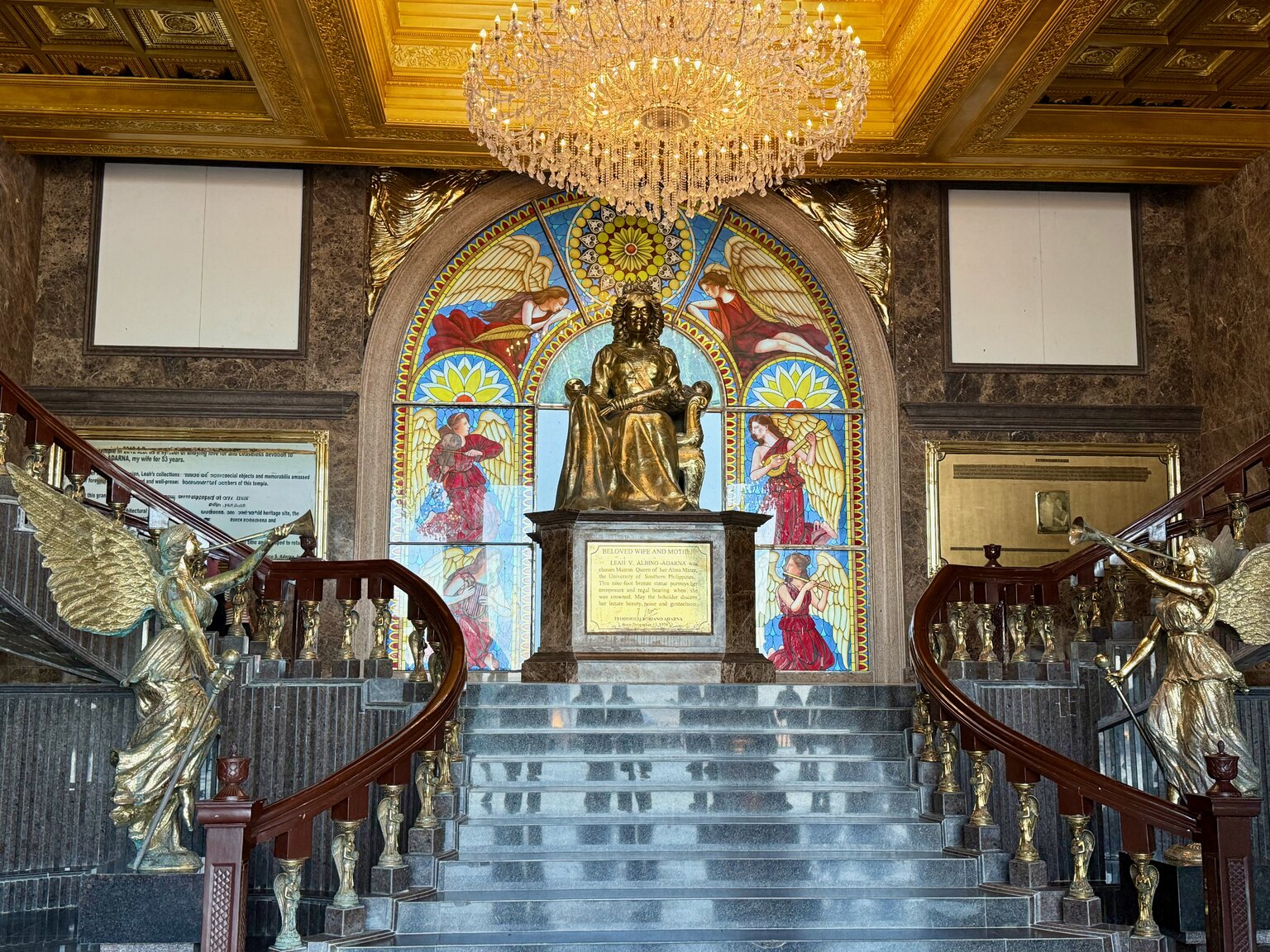
The Temple of Leah is a Greco-Roman inspired shrine built by a businessman, Fidel Sayson, as a monument to his late wife of 53 years. Construction began after her death in 2012, and the project grew: what started as a memorial became a hilltop complex of marble columns, lion sculptures, and imported stone. The rooms inside hold Leah’s personal collection of furniture and awards, and I have seen many lavish rooms in my life, so they were not what stopped me. What was remarkable was that it was marble on a hillside in Cebu. The statues and the ceiling of the grand entrance hall are something to stand under for a while. The large marble figure of Leah presiding over the staircase makes the scale of the devotion immediately legible.
I arrived a bit before golden hour with my selfie stick (that I always feel self-conscious using) and my camera. I toured through everything, had a snack at the café on the premises, then got to work on the angles. The selfie stick turned out to be genuinely useful. There is a reason you see them extended into the air at every tourist site across Asia.
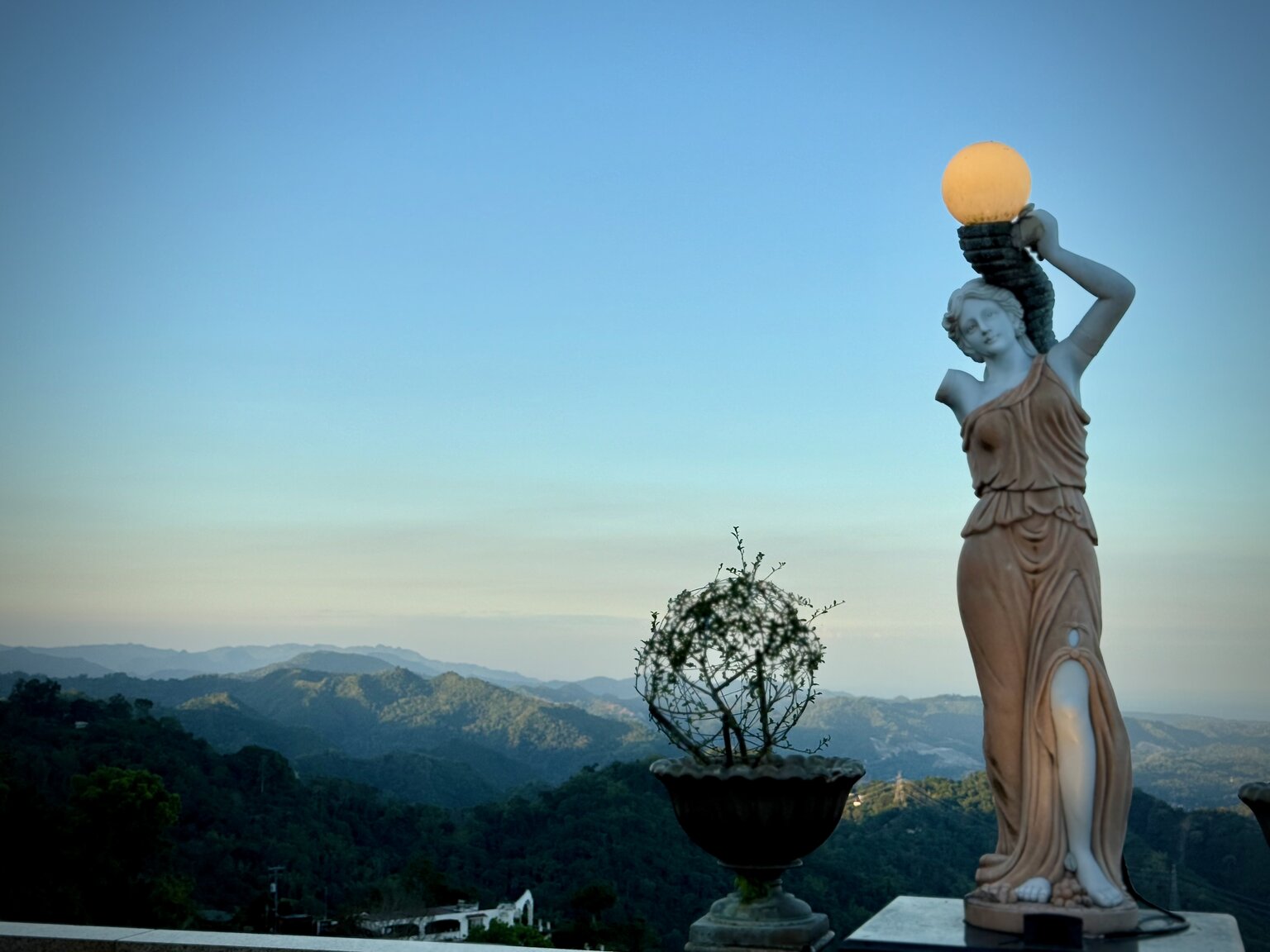
As the sun got lower, the marble caught the light differently. The courtyard lamps came on before I had noticed the light going. The hill is high enough that the whole city opens out below you, and when the light goes soft it is a genuinely good place to be standing. I took more photographs than I needed, and none of them quite worked. Being there was better than any of them.
When my Grab driver arrived to take me back down the hill, he was surprised I was touring alone. I explained that John’s semi-retirement still involves working US hours a couple of days a week, which means late-night meetings and a strong preference for sleep over sightseeing the following morning. The driver was insistent that no one should visit a monument to love without their significant other. I passed along what John had told me before I left: “I love you, but I’m not going to build a temple to your memory.” The driver wasn’t quite sure what to do with that.
Cebu Taoist Temple
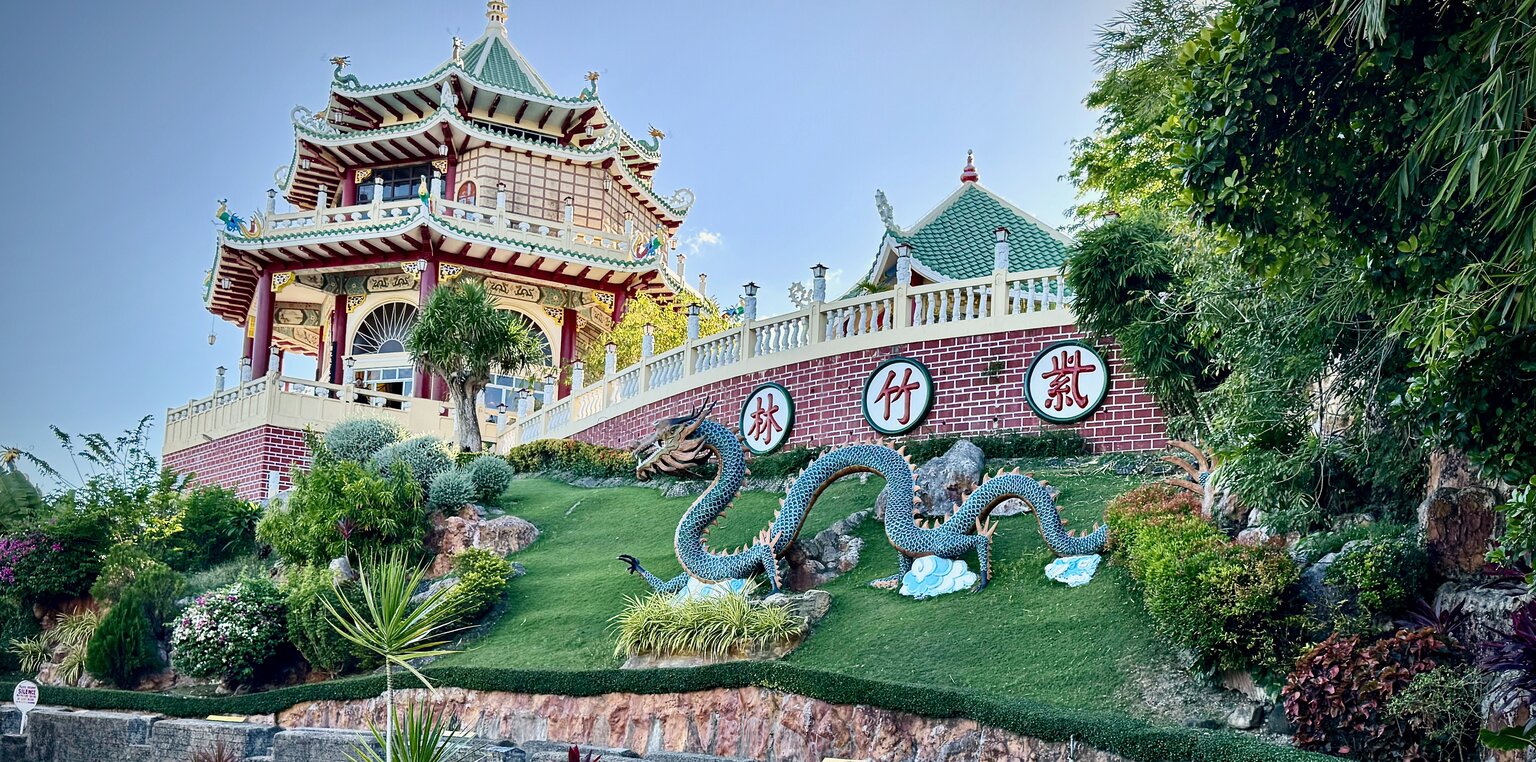
My last tourist visit in Cebu was the Cebu Taoist Temple, up in the hills in the Beverly Hills subdivision, not as high as the Temple of Leah. The temple was built by the Chinese Filipino community in 1972, on land in one of the city’s wealthier residential areas. The Chinese Filipino community, known locally as Tsinoy, has been present in Cebu for centuries, arriving as traders long before Spanish colonisation. The temple has 168 steps leading up to the main shrine, a number considered lucky in Chinese tradition, its pronunciation resembling the phrase “fortune all the way.” I was looking forward to the architecture, and to seeing a great many dragons.
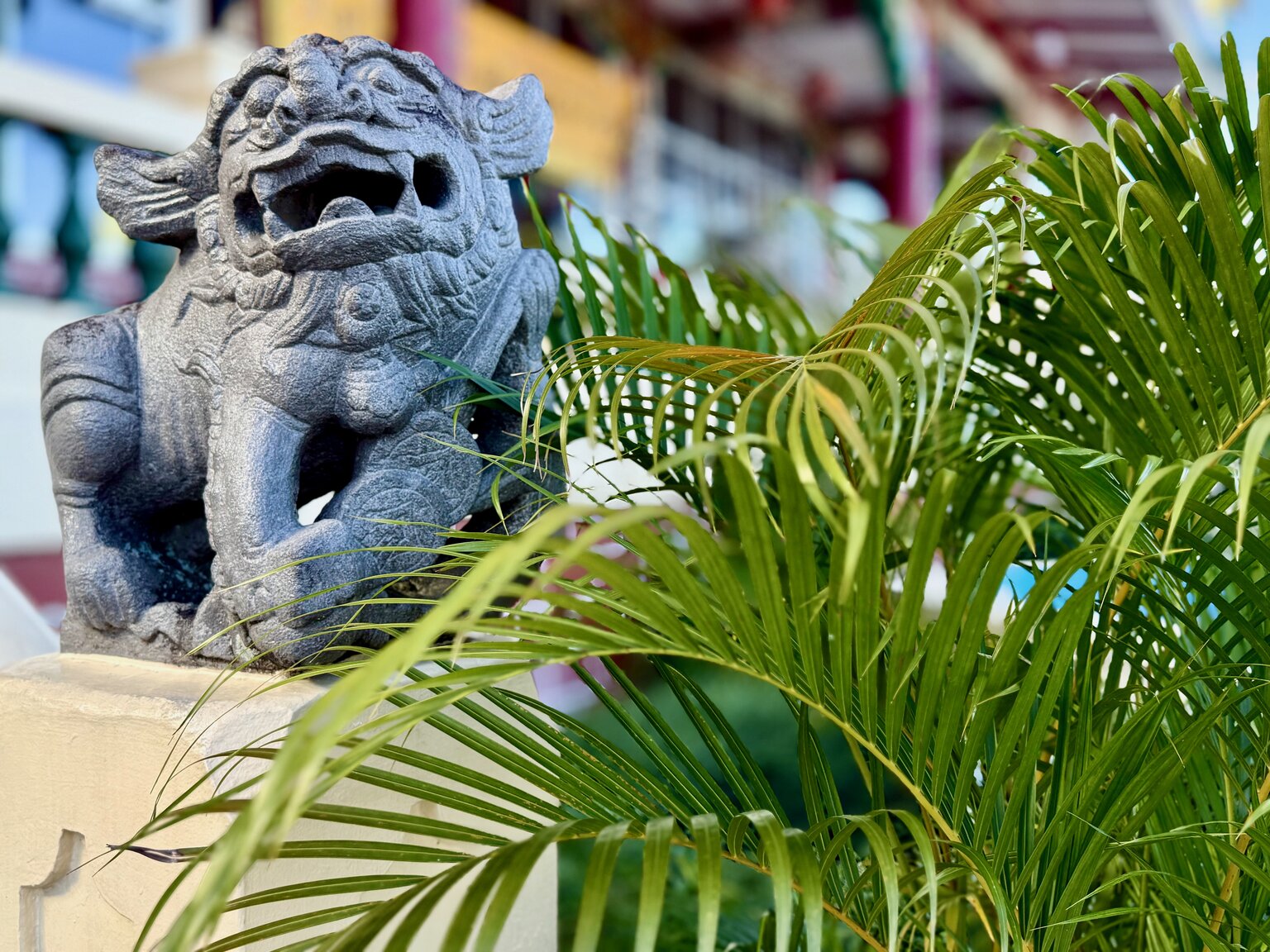
The stairs are considerable. This was good for my general health and hard on my osteoarthritic knee. Each level offered something different: dragons across nearly every roofline, tile work, incense, shrines, and long views into the city below. It was genuinely calm in a way I had not expected from a place on every tourist itinerary in Cebu. I took my time, sat down several times, and let the place settle rather than rushing through. The vibrant colours and the angles kept my camera busy for longer than I had planned.
The Macs