
Twenty-five hours is a long time to be in motion.
We knew that going in. We had done the maths, traced the route on a map, counted the legs. Seattle to Incheon, Incheon to Cebu City. Two flights, one layover, fifteen time zones, and whatever was left of us at the other end. But knowing the number and living inside it are different things, and by the time we set our bags down in a flat in Cebu at five minutes to midnight, we had lived thoroughly inside it.
The slow start
The day started early and slowly. We left the home we had been staying at with family at eight in the morning, which sounds like a reasonable hour until you remember that our first flight did not leave until half past twelve. That gap was deliberate given the current TSA situation. We wanted time to settle into the airport rather than sprint through it, and SEA obliged with a lounge, Negronis, coke zero, and a couple hours of nothing in particular. It was the last easy stretch of the day, though we did not fully appreciate that yet.
Twelve hours over the Pacific
<figure class=“post-image post-image-inline post-image-right”> <img src=“/assets/images/crossing-date-line-over-pacific.jpeg” alt=“In-flight route map on a seatback screen showing the Pacific crossing with 11 hours and 17 minutes remaining.” loading=“lazy” /> <figcaption>Somewhere over the Pacific, with 11 hours and 17 minutes still to go.</figcaption> </figure>
The flight to Incheon was eleven hours and fifty-five minutes. Nearly twelve hours over the Pacific, which is the kind of duration that sounds manageable when you book it and becomes a test of character somewhere around hour seven. We had planned to sleep. We did not sleep. What we did instead was watch four films, none of them memorable, and take periodic laps around the cabin while other passengers slept peacefully in positions that did not seem physically possible. By the time the cabin lights came up for the descent, we had that peculiar brand of tiredness where everything feels slightly shifted, like the world is running on a two-second delay.
We crossed the date line somewhere over the Pacific, which meant we departed on one day and arrived in the late afternoon of the next, having skipped a night’s sleep and lost a calendar day we would never get back. There is no version of this arithmetic that makes intuitive sense. You simply accept it, set your watch forward (oh wait, that happens automatically when you leave airplane mode), and try not to think too hard about what time your body believes it is.
The layover we got wrong
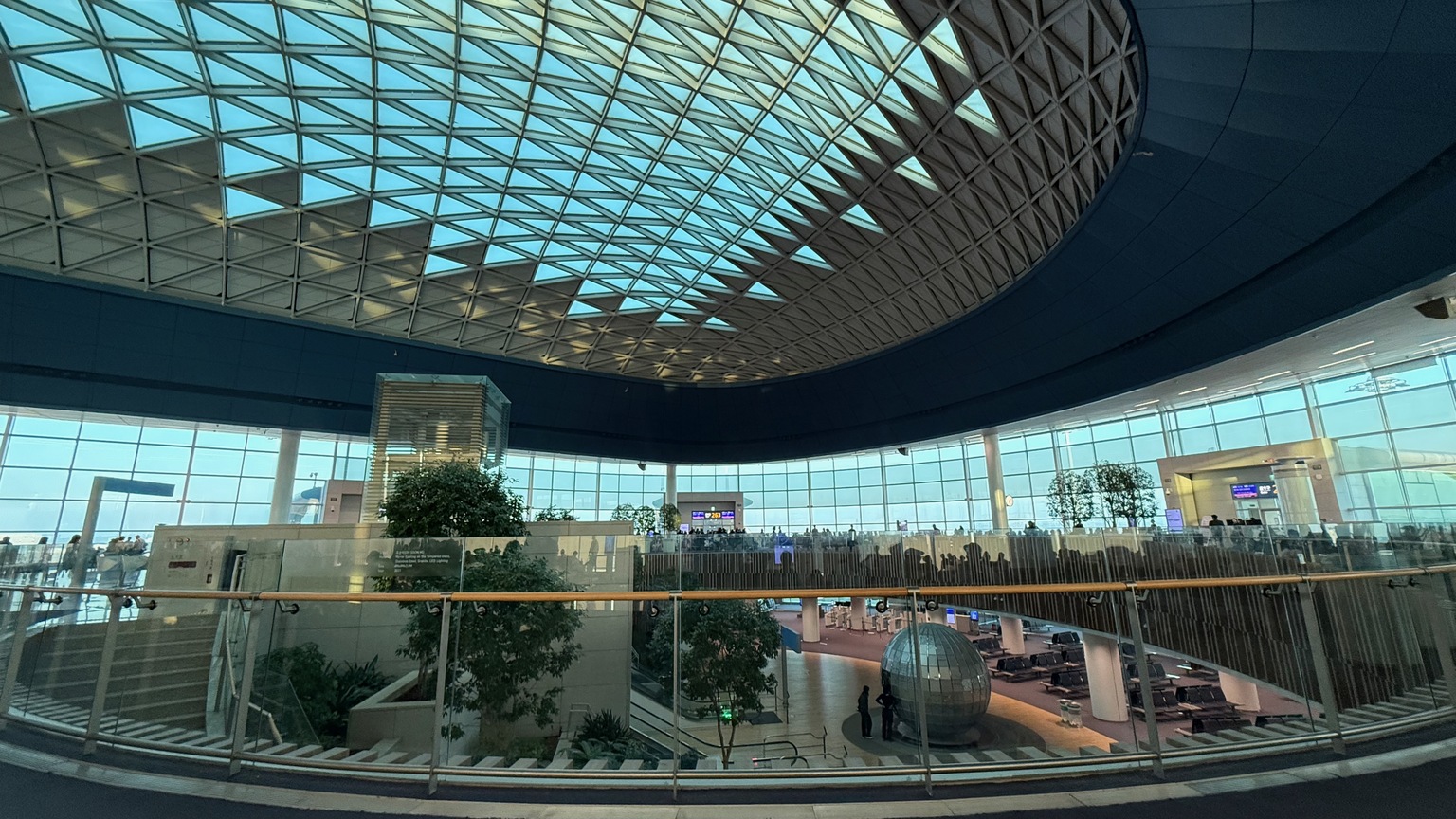
Incheon is an enormous airport, and at half past four in the afternoon Korean time, with a roughly two-and-a-half-hour layover ahead of us, it offered just enough time to stretch, eat, and feel briefly like people who were not trapped in a pressurised tube.
We did not use that time well enough.
<figure class=“post-image post-image-inline post-image-left”> <img src=“/assets/images/incheon-robot-gimbap.jpeg” alt=“Robot gimbap restaurant in Incheon airport, with its illuminated sign, ordering screen, and travellers sitting nearby.” loading=“lazy” /> <figcaption>The robot gimbap restaurant we saw, admired, and then inexplicably failed to use.</figcaption> </figure>
There was a robot gimbap restaurant in the terminal, fully automated and with no human staff, the kind of thing you would photograph and talk about for weeks. We saw it. We registered that it was interesting. And then we walked past it because we were too tired to process a menu, robotic or otherwise. This is the sort of decision that feels perfectly rational at the time and becomes a genuine regret by the following morning. We should have sat down and let the robots feed us. Lesson noted for the next trip, or for any future layover where fatigue is whispering that it is easier to just keep moving.
Instead, we just sat at a gate and ate snacks from our bag, and waited. The layover stretched a little longer than expected, with a ground services delay adding perhaps thirty minutes, and by the time we boarded the second flight, we had been in transit for close to twenty hours. The remaining four and a half to Cebu felt, paradoxically, shorter. Maybe we had broken through some wall. Maybe the body just stops counting after a certain point. Also, Korean Air had better food.
Midnight in Cebu
We landed in Cebu City late. Very late. And this is the part that still surprises me, even though it should not: how smoothly the mechanics of arrival worked in a place we had never been.
We cleared immigration. We collected our bags, although one took long enough to make us wonder. We walked out of the terminal into warm, humid air, the first indication that we were somewhere genuinely tropical and not just in another airport corridor. And then we opened an app, requested a Grab, and watched a car appear on the screen, heading toward us.
We gave the driver an address.
He drove us there.
We arrived.
It was 11:55pm, Cebu time. Twenty-five hours since we had left home.
The cost and the point
There is something worth pausing on here, because this is the kind of thing that gets lost between the highlight photos and the arrival posts. The actual labour of long-haul travel, the dead hours, the failed sleep, the recycled cabin air, the disorientation of crossing time zones, is real and cumulative. It costs something. By the time we walked into our flat, we were operating on residual momentum and not much else.
But the other side of that exhaustion is this: we had just crossed the Pacific, landed in a city neither of us had visited, and within forty minutes of clearing arrivals, we were standing in a flat with a bed and a lock on the door. No local guide, no complicated negotiation. Just an app, an address, and a driver who knew the roads.
That is not nothing.
One of the quiet convictions behind this trip is that most things can be figured out. Not effortlessly, not without occasional confusion, and certainly not without the kind of tiredness that makes you question whether buying a one-way ticket to Southeast Asia was a sound decision. But figured out nonetheless. The infrastructure exists. The tools work. People are generally helpful if you are generally polite. And even at midnight, on the far side of the world, after twenty-five hours of travel, you can get from an airport to a bed without drama.
The next morning
We did not explore that night. We brushed our teeth, set an alarm that neither of us would need, and collapsed. The flat was fine, clean, air-conditioned, quiet enough. We would form opinions about it later. Right then, it was a horizontal surface in the right city, and that was all it needed to be.
I woke at six the next morning, still on Seattle time, and looked out a window.
We walked outside. The air was warm and thick, in a way that felt intentional, like the climate was making a point. I could hear roosters, plural, and traffic somewhere beyond the complex, and a conversation I could not follow but that sounded cheerful. We could not see the street from where we were, but we could hear the city getting on with its morning.
It was not Seattle, not Los Angeles. It was not anywhere I had been before. And after twenty-five hours of tin-can air and recycled films and airplane food and the slow grind of getting from one side of the planet to the other, it was exactly the feeling I had been hoping for. Not awe, not revelation. Just the plain, physical fact of being somewhere else. A different morning. A different set of sounds. A different version of ordinary life, carrying on around us.
Where the long way gets long
Seattle to Incheon. Incheon to Cebu City. Twenty-five hours, two flights, one regrettable robot restaurant decision, and no sleep worth mentioning.
The domestic chapter of this trip, selling everything, moving out of California, time in Seattle, Pasco, and New Westminster, had been a kind of warm-up. A way of learning how to move, how to pack, how to settle into unfamiliar places for a while. We had not known that at the time, but it was obvious now.
This was different. This was international. This was where the long way actually got long.
And standing outside at six in the morning, groggy and disoriented and not yet sure where to find breakfast, I had the distinct feeling that it had finally, properly begun.