
The Familiar Shape of Kuala Lumpur
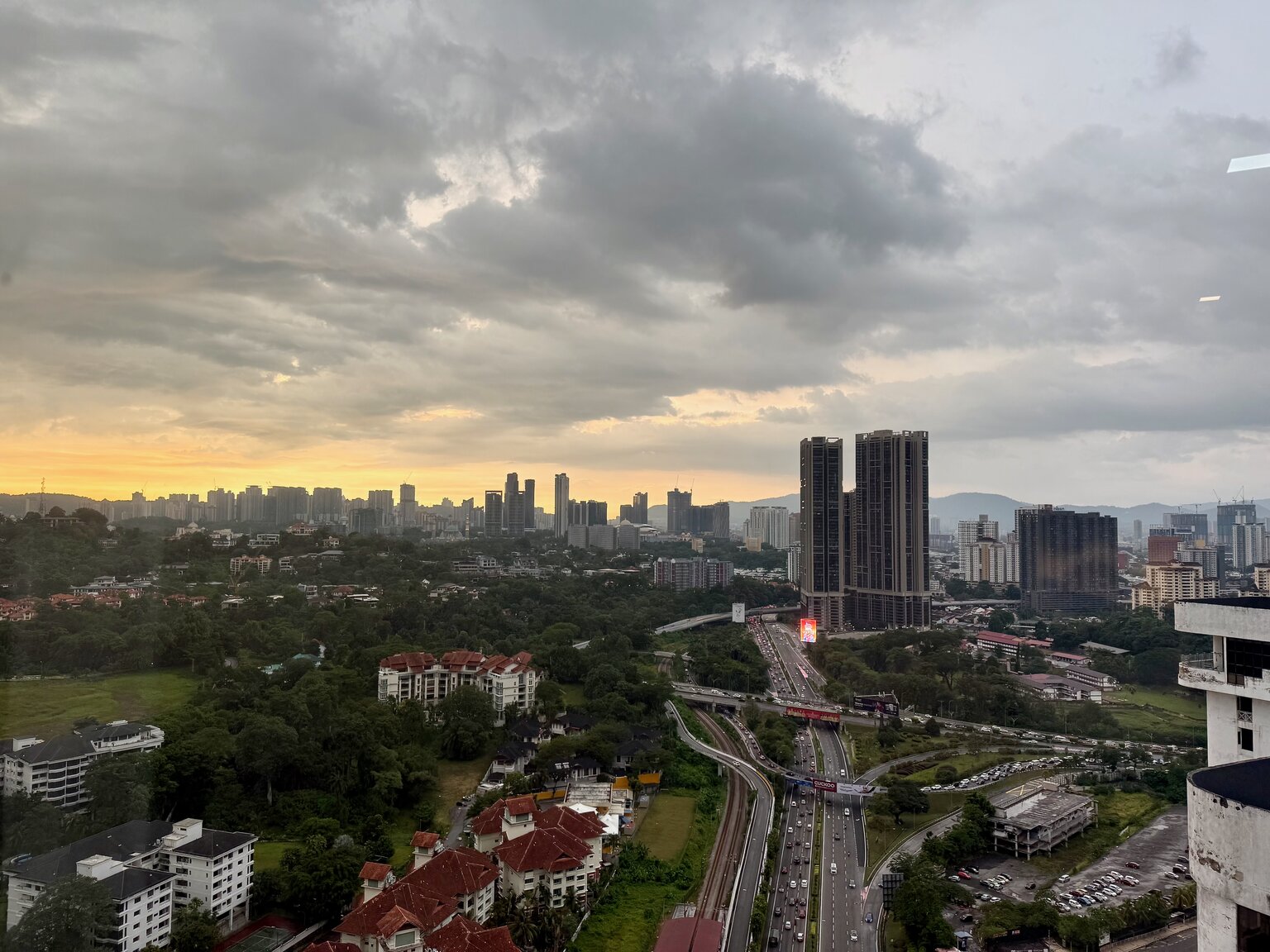
The view from the Airbnb was the first thing that made Kuala Lumpur feel familiar. Thirty-four floors up, with one wall made entirely of floor-to-ceiling windows and a skyline filling most of the view. We overlooked an orderly highway interchange, clumps of tall buildings, and hills in the distance. After Cebu’s lower, more fragmented skyline, this was a shape we recognised.
Cebu had made us realise how much of our lives had been built around a particular kind of city: freeways, clustered high-rises, and long suburban sprawl pushing toward the hills. The first morning, looking out at the haze and the towers, John said it looked like a chill LA. He was not entirely joking.
Freeways and traffic
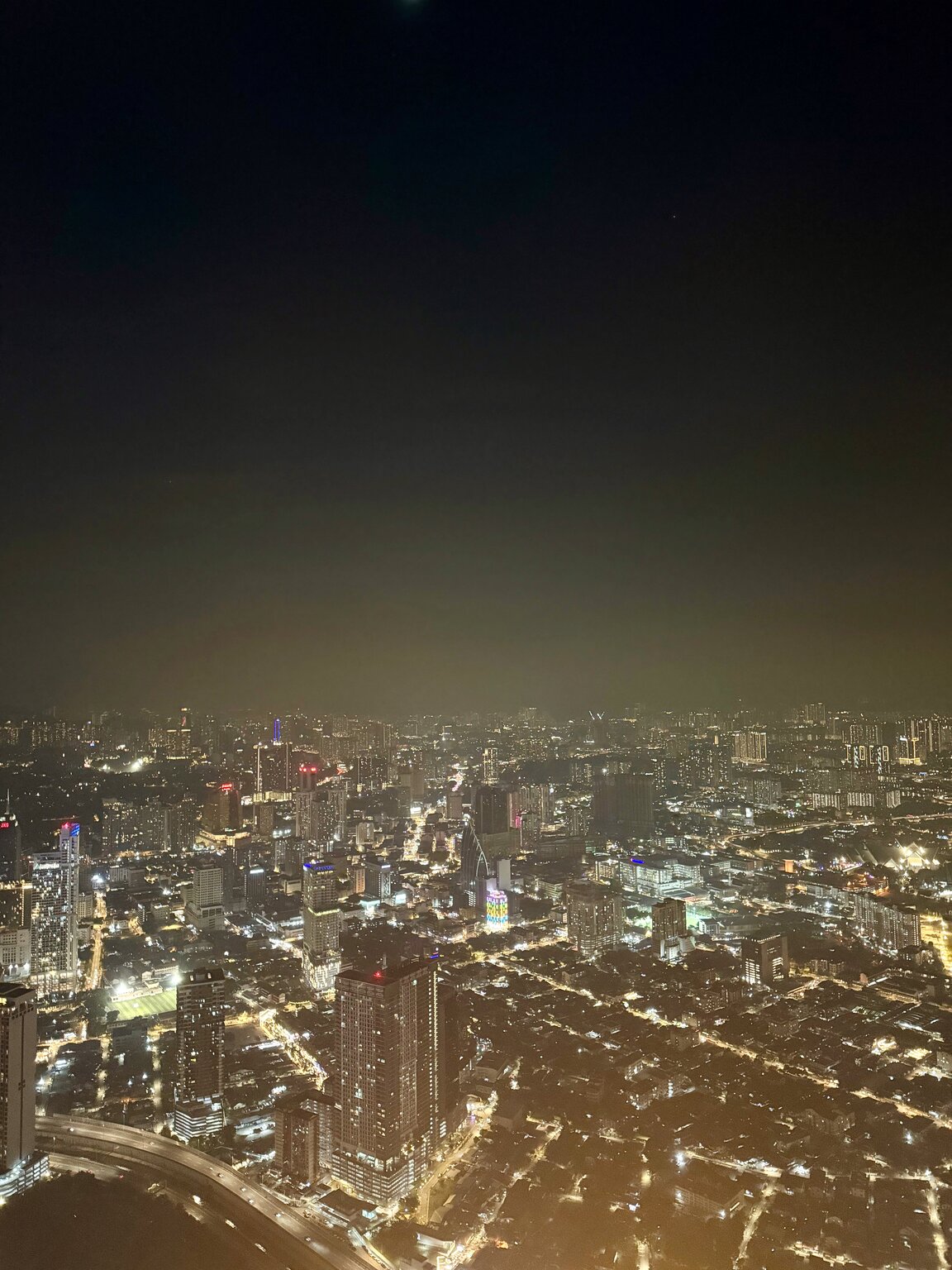
The only time we were really on the freeways was to and from the airport, which sits far enough out that the drive doubled as a long, sweeping tour of the city’s edge: long arcs of road, exit signs that read like instructions, the towers slipping in and out of view as we climbed and descended through the hills. Inside the city we took Grab or walked almost everywhere, mostly on surface streets, and the geography assembled itself one ride at a time: the Klang River, the cluster around KLCC, the older grid of the colonial centre, the shape of the neighbourhoods that ringed our part of town.
Traffic settles into predictable corridors and predictable hours. The honking is more polite. The motorcycles weave more confidently. An afternoon downpour can change a 20-minute trip into 50 without warning, and the drivers shrug at it the way LA drivers shrug at a closure on the 405. After Cebu, where every car ride was a small negotiation with a different road logic, the familiarity here was almost restful.
The streets at night kept the comparison going. We were here just after Hari Raya Aidilfitri, and the bridges over the main avenues still carried strings of light shaped into crescents, stars, and geometric flowers. Buses and motorcycles streamed under them.
Public transport, finally
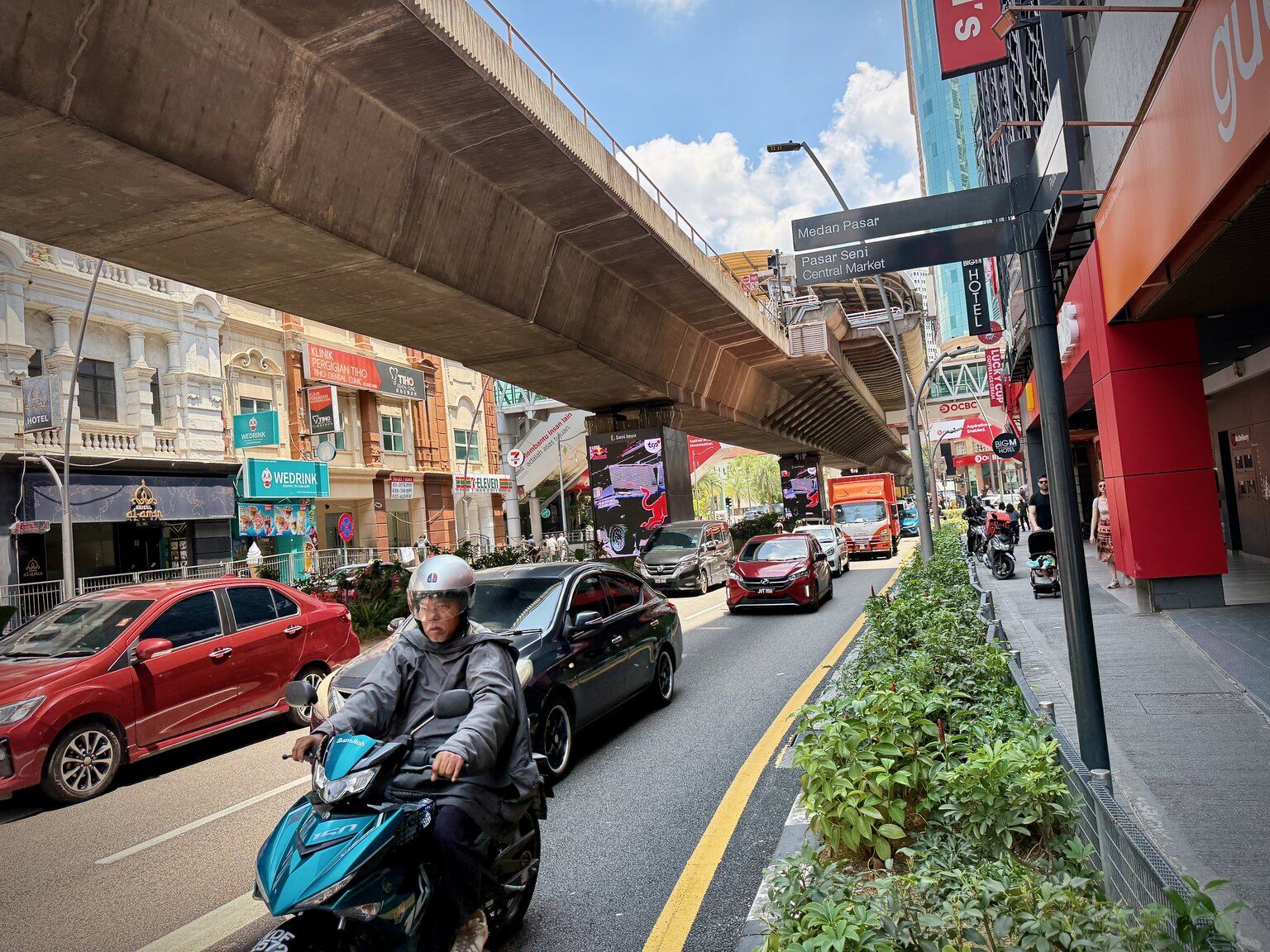
I rode the LRT several times in our first week, each trip a small revelation. Trains arrived when scheduled, the stations were clean, and the city unfolded differently from above the traffic. The first trip took me into the older part of the centre, where the city shifted register at street level: narrower buildings, more shop signage, the smell of something fried and warm. I had moved across a piece of the city in a way that would have taken half an hour and a Grab fare otherwise. I also took the hop-on hop-off bus, a different kind of revelation: a comfortable upper deck, a working route map, and, until the afternoon rain arrived, a city happy to be looked at.
The trains were the bigger surprise, though, and only because of how unfamiliar working transit had become. There was a stretch before the pandemic when we used the LA metro constantly. We even lived in an apartment next to the Red Line in North Hollywood for a time, and the train was simply how we got around. Then the world changed, the metro at home receded, and the habit went with it. Standing on a KL platform, the muscle memory came back: where to wait, how to read the signage, the small intuitions of a transit rider. It was a luxury I kept noticing.
We also walked more than we had in years. The footpaths are uneven and the curbs sometimes vanish, but in our neighbourhood we could be at a market, a mall, or a temple within twenty minutes on foot. We had not planned for that. The Airbnb was chosen for the view and the size. The fact that daily life sat within walking distance reframed how we thought about where we had been living.
Sunway Putra
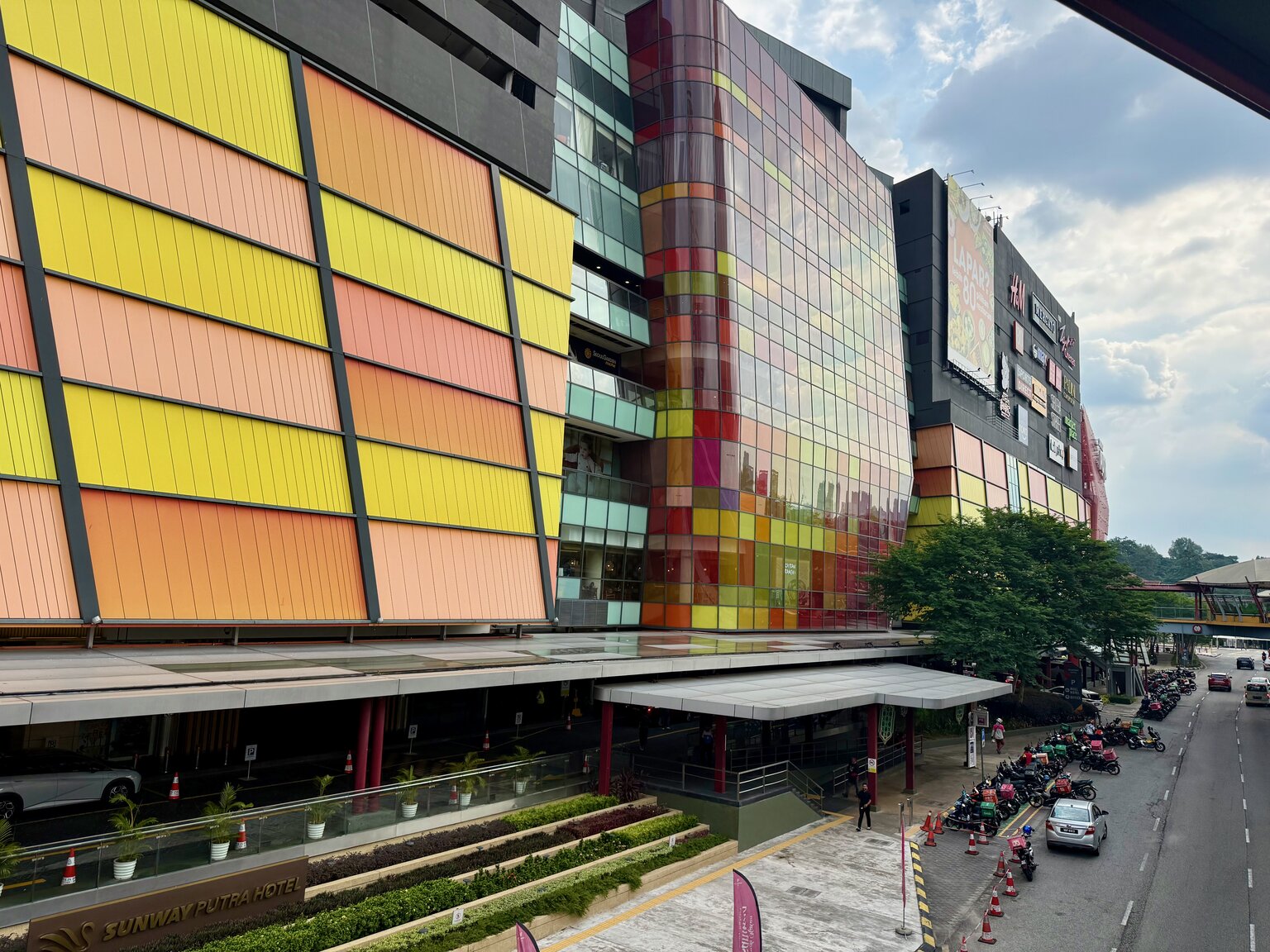
Our Airbnb was nearly next door to Sunway Putra Mall, which became a quiet anchor in our routine. The façade is made of fused panels of yellow, pink, red, and orange glass, set in a slightly off-grid pattern that catches the light differently in the morning and afternoon. The first time we walked past it I assumed it was a hotel, then a museum, then a convention centre. It turned out to be a mall on top of all three.
Inside, it is the kind of mall LA does not really have any more: full, mid-tier, treated as a piece of the city rather than a destination. People came for groceries, for haircuts, for the food court at lunch, for the air conditioning during the worst of the afternoon. The mall became one of those fixed points that quietly structures daily life as a place to pass through several times a week.
Petaling Street and Brickfields
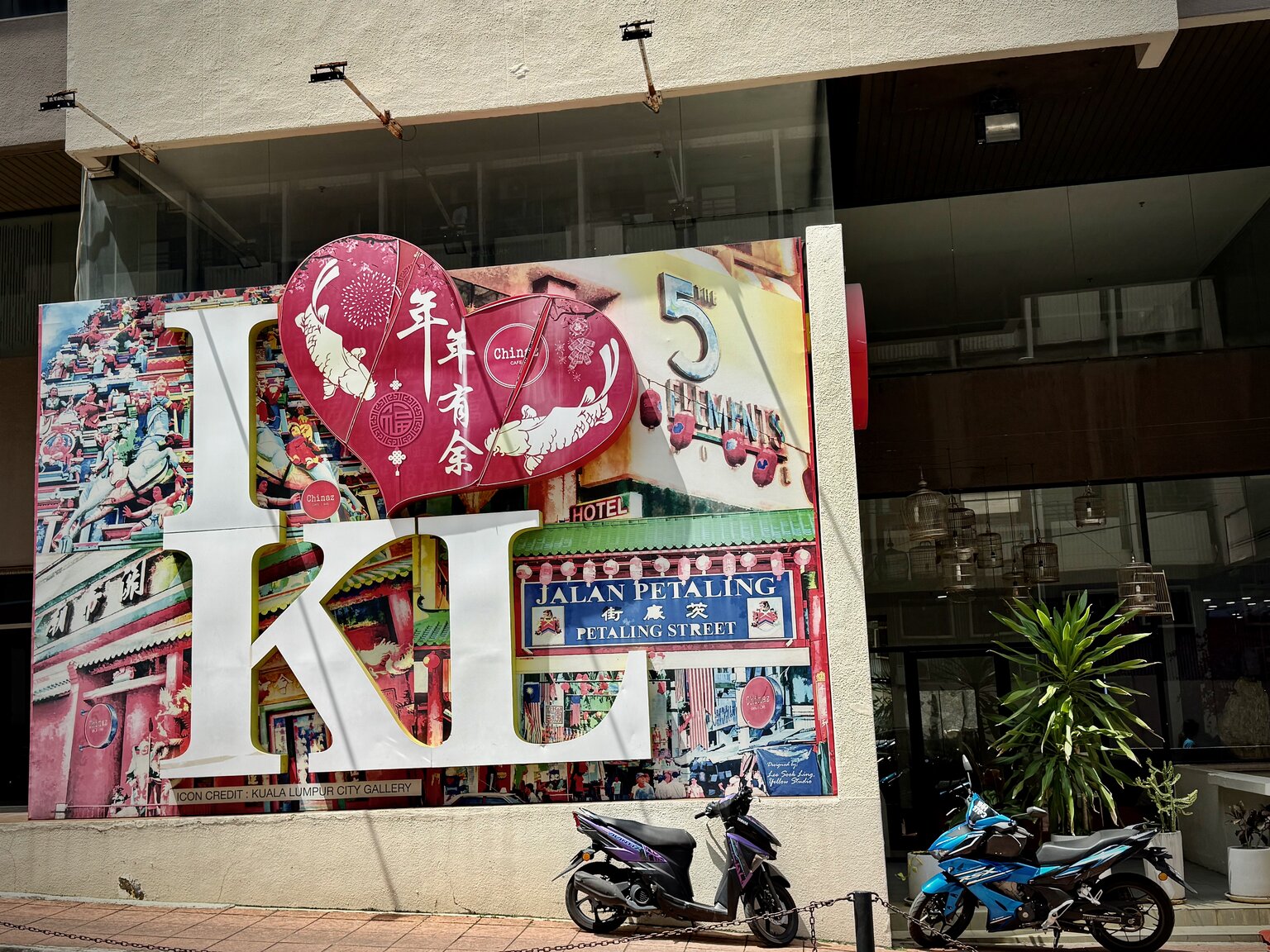
I used the hop-on, hop-off tour bus to explore Petaling Street, in the city’s old Chinatown. The famous markets are in narrow streets that are crowded even at 10 am. Several cars and motorcycles honked as they attempted to drive through the streets as vendors set up their stalls for the day. Customers were already searching for the next bargain. After wandering through the area, I began to retrace my steps to get back to the bus stop. That’s when I noticed a sign near the entrance to one of the side alleys: a bright “I ❤ KL” set against a collage of street scenes, with “Jalan Petaling” in painted letters down one side and a row of motorcycles parked in front of it.
It reads as cheerful local pride more than a tourist photo-op, although it functions as both. The street across from it is busy with the original purpose: cheap copies, hawker food, durian carts, regulars sitting at the same plastic tables they sit at every week.
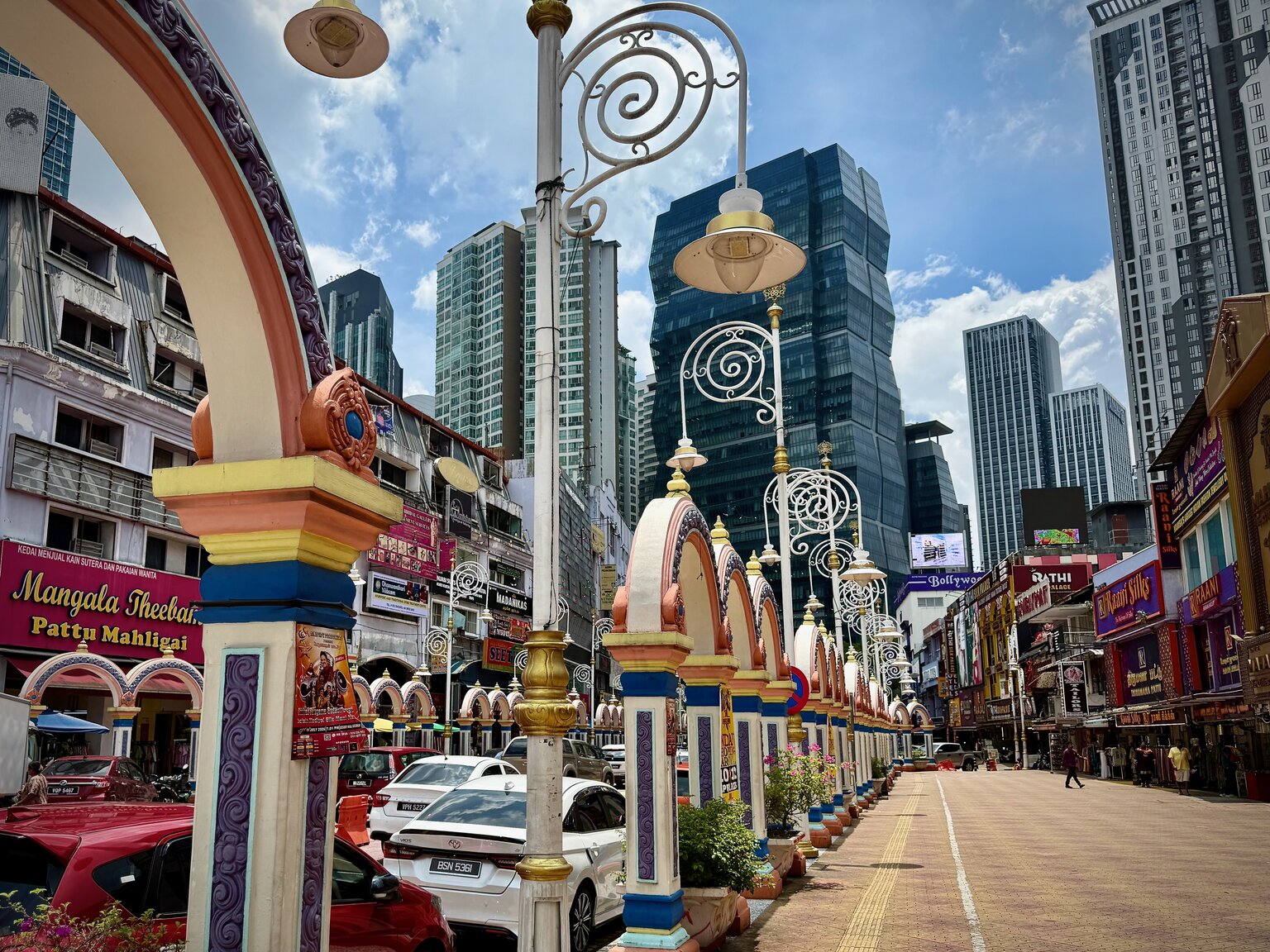
Further south, Brickfields is the city’s Little India, but despite the signs, it feels less like a tourist district than a working neighbourhood with a long memory. Painted arches step down the main street, the lampposts are ornate and brightly coloured, and saree shops and Indian sweet stalls sit alongside ordinary apartment blocks and a working KL Sentral station.
Behind it all, the high-rises of KL Sentral push up through the frame. This is what KL keeps doing: stacking the layers and letting them sit in the same view. I walked Brickfields slowly, listening to the languages around me, Tamil and Malay and Mandarin and English layered into one street.
By midday I escaped the heat into a small café crowded with lunchtime regulars. Plates of curries, rice, and papadam moved quickly from kitchen to tables as seats filled almost as soon as they emptied.
Merdeka 118
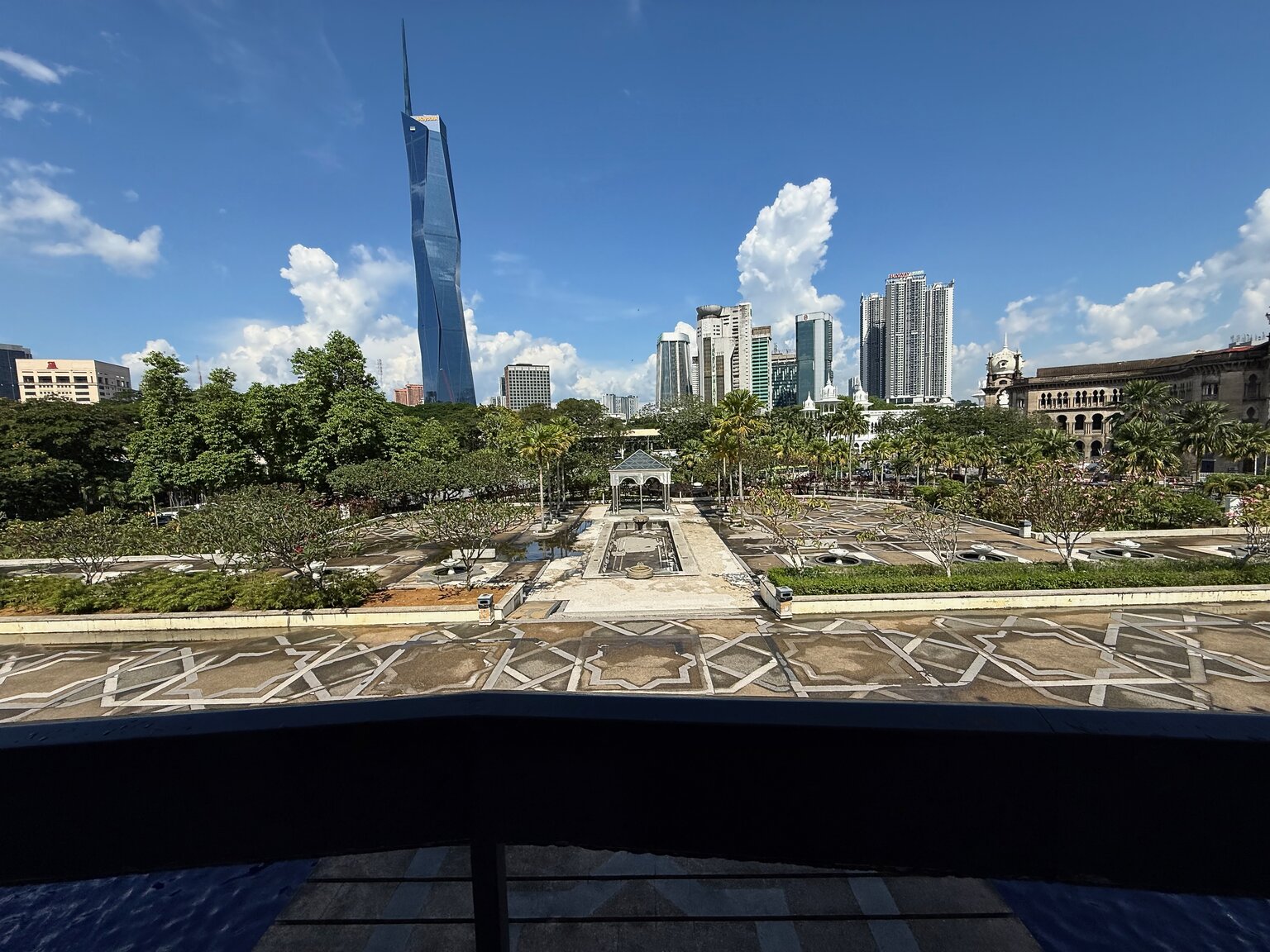
Merdeka 118 is the second-tallest building in the world, visible from almost everywhere, but the angle that stayed with me was from the National Mosque. A wide terrace, the floor laid out in a pale star pattern, opens onto a stand of palm trees, and the tower rises behind them in clean profile.
Standing on the mosque’s terrace and looking back at the skyline, you can see Kuala Lumpur’s whole architectural argument compressed into a single view: independence-era civic buildings, the colonial railway station, the museums clustered around the Lake Gardens, and behind all of them, the tower.
The Petronas Towers are still the postcard, of course, and they deserve a post of their own. Merdeka 118 is doing something different. Its offset spire is widely understood as a reference to Tunku Abdul Rahman, Malaysia’s first prime minister. In 1957, after the Union Jack was lowered and the Malayan flag raised at Merdeka Square, he called out “Merdeka” seven times with his right hand raised. The tower’s silhouette echoes that gesture: modern, declarative, and tied to the moment the country announced itself.
A green register
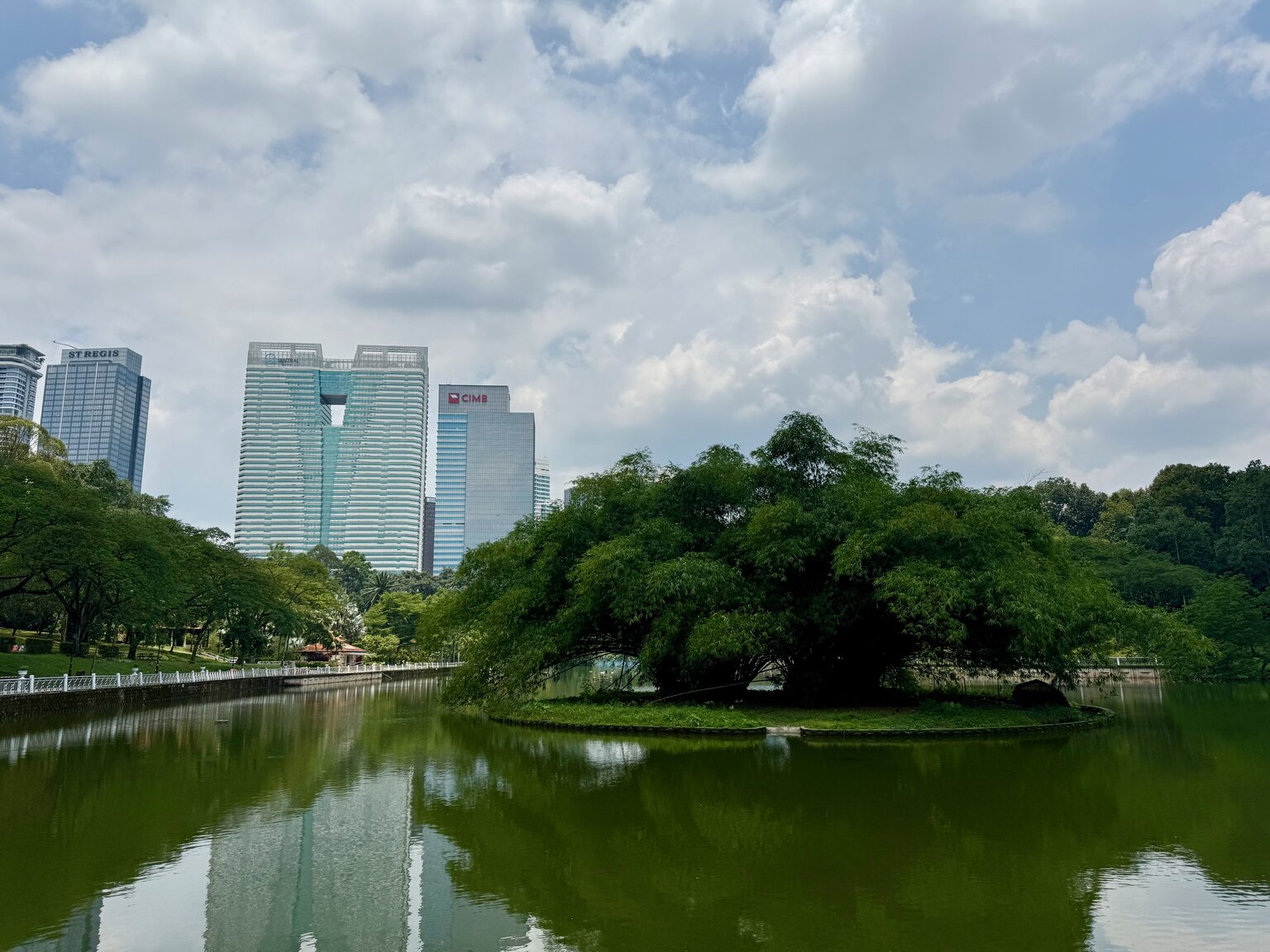
For all the highways and towers, KL has a green register that surprised us. The Perdana Botanical Garden is one of those places that feels more accidental than designed. It sits in the old Lake Gardens, a 19th-century landscape that once belonged to the colonial government and now belongs to the city. Bird parks, butterfly parks, an orchid garden, and a deer enclosure sit stitched along walking paths that wind around a lake.
The most striking thing is the proximity. From the lake, you can see the towers of the city centre over the trees, the way Central Park frames the Manhattan skyline. I sat on a bench by the water and cooled down before walking on to find food. The towers were there, behind everything, but the soundtrack was birds and insects.
A city in a good mood with itself
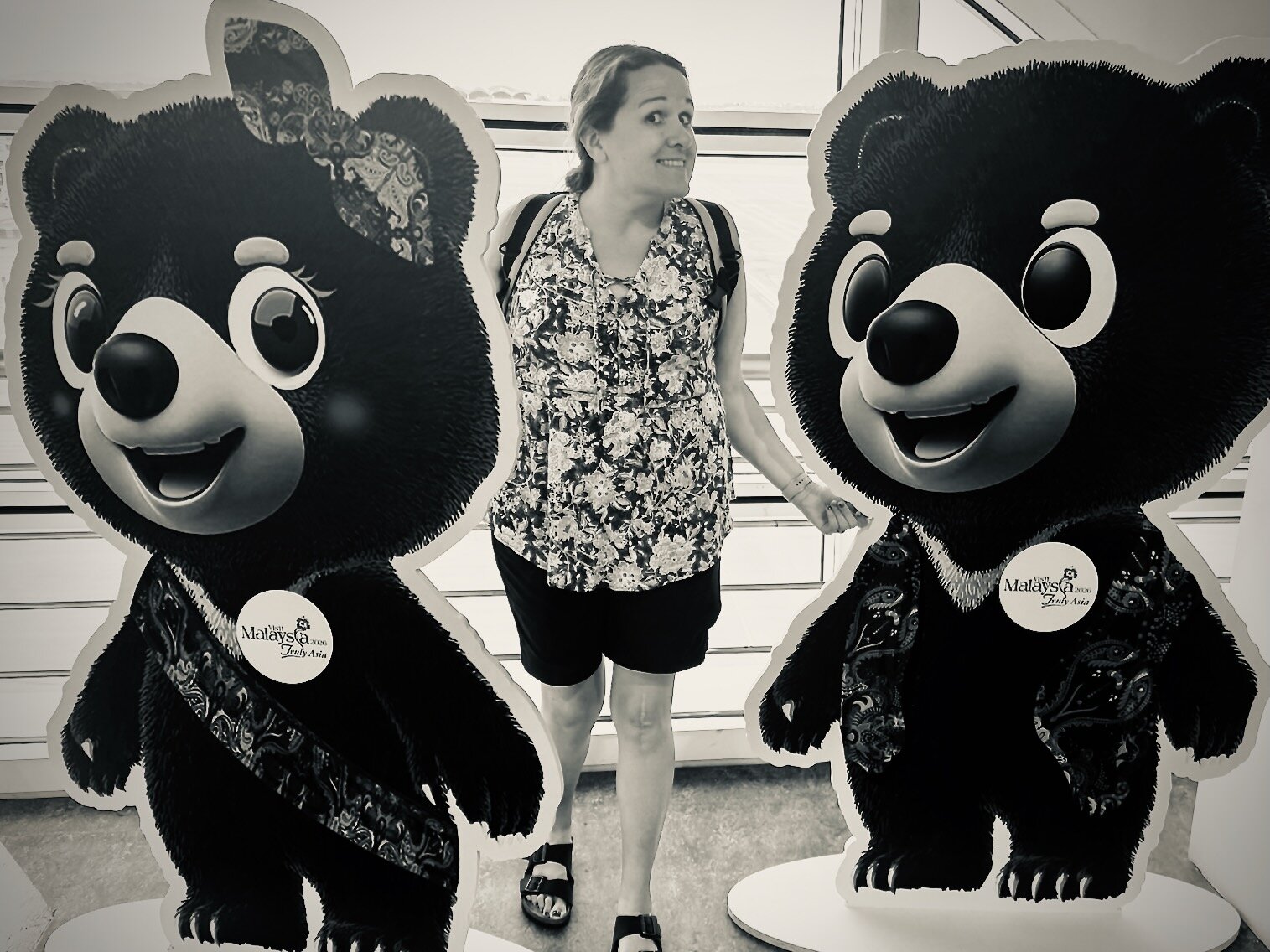
Tourism here this year has its own mascot. Malaysia is running a Truly Asia 2026 campaign, and life-sized golden bears keep turning up in airports, hotel lobbies, and museum courtyards, dressed in batik and posed with the kind of stiff cheer that tourism mascots manage everywhere. I caught two of them at KLIA airport on our way through, found them absurdly charming, and made John take the photo. Malaysia does cute in a way LA mostly does not.
Cities are easier to like when they are confident enough to be cheerful about themselves. KL was, for the time we were there. The bears, the Aidilfitri lights, the Petaling Street mural, the families gathering in the park at KLCC each evening: none of it was performed for us, but none of it was hidden either. It was a city in a good mood with itself.
What I keep coming back to is the simple fact that Kuala Lumpur was the first place in months that felt immediately legible to us. The shape is familiar. The details are not.
The Macs